
Twenty Years of Trit: Looking Back … And Looking Forward
Twenty years in design is a long time.
Long enough for trends to disappear, reappear and somehow find their way back into our projects again. Long enough for catalogues and print advertisements to give way to Instagram, influencers and algorithms. Long enough for the way we shop, specify, manufacture and even discover furniture to change almost beyond recognition.
And for Trit House, it has been twenty years of changing right alongside it.
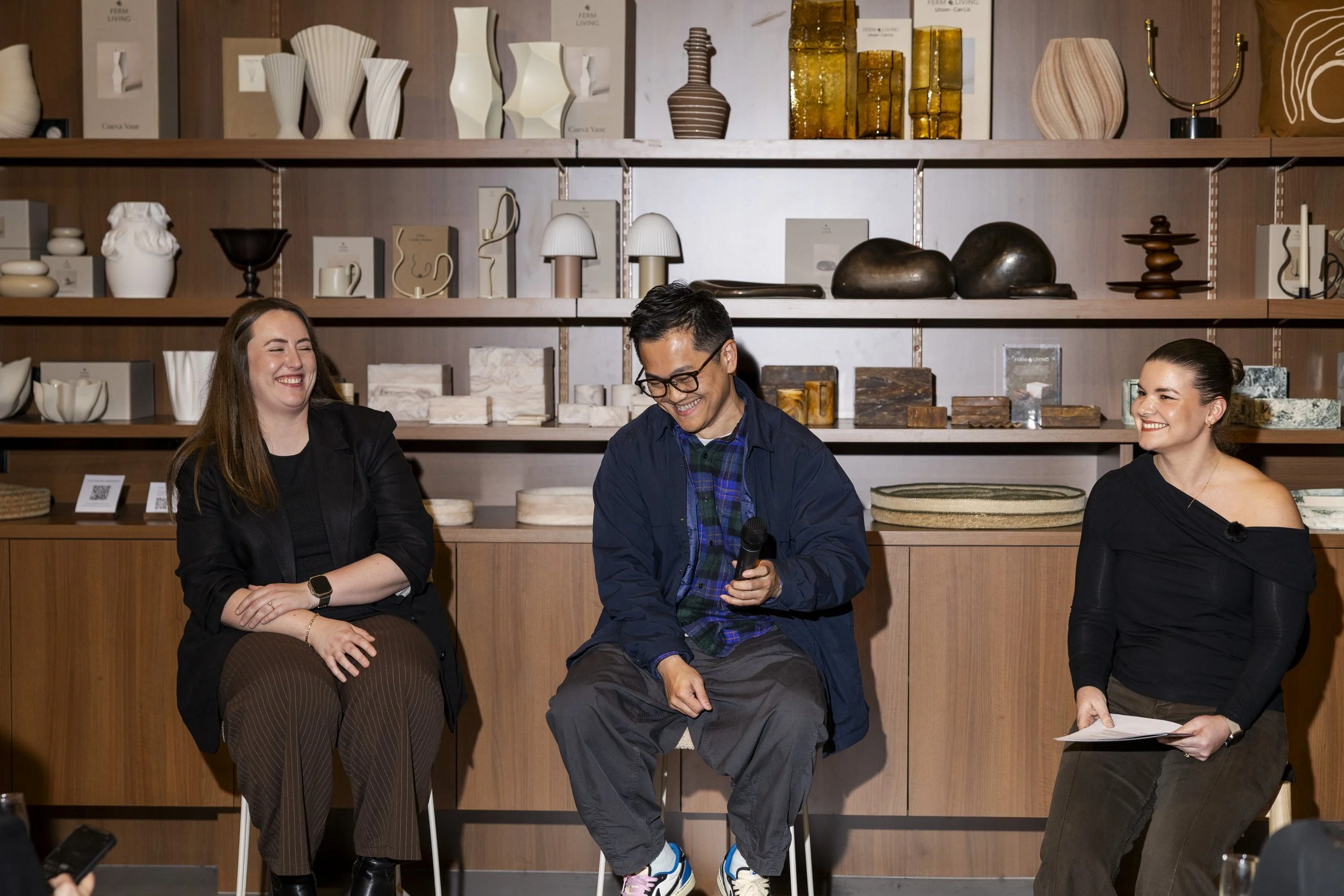
To celebrate the milestone, Trit brought together members of Melbourne’s design community for an evening reflecting on two decades in business: the ideas that shaped the company, the trends that came and went, the partnerships that changed its direction and, perhaps most importantly, what the next twenty years might look like.
Moderated by Melbourne interior designer and Trit Trade Consultant Holly, the conversation brought together Trit founder Ivan and long-standing team member Eliza to look back on a business that, in many ways, entered the Australian furniture industry completely backwards.
Starting Online Before Moving Offline
Today, discovering a furniture brand online before visiting a physical showroom feels entirely normal.
Twenty years ago, it was anything but.
Rather than beginning with a traditional bricks-and-mortar furniture store and later moving online, Trit built its earliest customer experience around a curated digital offering first.
The idea was simple: bring together interesting, considered furniture and make good design more accessible to Australians through an online platform.
The physical experience came later.
As Trit grew, so did the desire for customers and designers to experience its collections beyond a screen — to sit, touch, compare materials and understand the scale and craftsmanship of the furniture in person.
The transition into physical retail eventually became an important part of Trit's evolution, growing from its digital beginnings into showrooms and design destinations across Australia.
It was an unconventional growth model at the time. But looking back twenty years later, perhaps being comfortable doing things differently from the beginning helped prepare the business for an industry that would never stop changing.
From Magazine Pages to an Always-On Design World
The way Trit communicates with its audience has transformed just as dramatically.
Twenty years ago, building a furniture brand meant investing heavily in traditional media.
Print advertising, magazine editorials, catalogues and carefully planned publication features played an enormous role in introducing consumers to new designers and products.
Today, the communication landscape is considerably more fragmented — and considerably faster.
Collaborations, social media, influencer partnerships, digital advertising, content creation and an ever-expanding number of platforms now sit alongside the traditional channels that helped establish Trit in its earliest years.
For a business built around discovery, embracing those new ways of communicating has become part of remaining relevant.
The platforms may have changed, but the fundamental objective hasn't: finding interesting design and finding interesting ways to introduce it to people.
Eleven Years From the Inside
Few people have witnessed that evolution as closely as Eliza.
A permanent fixture within Trit and someone who has worn more than a few hats during her eleven years with the company, Eliza joined the discussion to reflect on just how much the business has expanded around her.
From the development of physical showrooms to an increasingly diverse portfolio of international and Australian brand partners, she has watched Trit evolve from a furniture retailer into something much broader.
The growth hasn't simply been about becoming bigger.
It has been about becoming more considered.
New brands, new spaces and new capabilities have gradually expanded what Trit can offer residential customers, interior designers, architects and commercial specifiers — creating the layered design destination the business represents today.
And that evolution has happened alongside some fairly dramatic changes in what Australians actually want to put inside their spaces.
Twenty Years of Changing Taste
Look back at Australian interiors from twenty years ago and the design landscape feels distinctly different.
Retro-inspired furniture remained prominent before Scandinavian design began to exert an enormous influence over Australian interiors. Pale timbers, restrained forms, functionality and a certain Scandinavian minimalism became deeply embedded in the way Australians approached contemporary design.
Today, the landscape is harder to define — and Trit considers that a good thing.
Australian interiors are increasingly comfortable mixing influences.
Italian design can sit beside Scandinavian pieces. Sculptural European furniture can be combined with vintage references, richly textured upholstery and natural Australian architecture.
We have become, as Ivan describes it, a little more "mixed".
Rather than subscribing to one design movement, designers and consumers are increasingly confident creating spaces from multiple influences, periods and cultures.
Individuality has begun to replace the rulebook.
Although, as Ivan jokingly acknowledged, Australia can still occasionally find itself a few years behind Europe when it comes to fully adopting the newest design obsession.
Everything Comes Back Around
Some trends disappear.
Others come back bigger & better than before.
Velvet, bold upholstery and the unmistakable influence of the 1970s have returned repeatedly throughout Trit's twenty years — resurfacing in new colours, silhouettes and applications.
But today's revival comes with one important difference: technology.
A velvet sofa twenty years ago and a velvet sofa today may appear aesthetically connected, but advances in performance fabrics, manufacturing and finishes have fundamentally changed what those pieces are capable of.
Materials can now offer dramatically improved durability, stain resistance and commercial performance without sacrificing the tactile quality that made designers fall in love with them in the first place.
It means designers no longer necessarily have to choose between an aesthetic idea and a practical one.
A trend can return stronger than before because the materials supporting it have caught up.
The seventies may be back… but the technology definitely isn't.
The Material That Never Left
Then there are the trends that never really disappear at all.
For Trit, natural materials sit firmly in that category.
Natural timber, stone, tactile surfaces and honest finishes have remained a constant throughout changing design movements — providing a grounding presence while trends evolve around them.
You can see that philosophy reflected through one of Trit's longest-standing relationships, Ethnicraft.
Where other aesthetics have cycled through popularity, the appeal of natural timber has endured because it rarely belongs exclusively to one moment.
Beautiful material has longevity.
It can age, soften and develop character. It can work inside a highly contemporary space just as comfortably as it can within something more traditional.
For Trit, that ability to transcend a specific trend is an important distinction between furniture that simply feels fashionable and furniture that continues to feel relevant.
So, Where Do Trends Actually Come From?
For a company built around curation, Holly posed an obvious question to Ivan:
When Trit is looking for what comes next, where do you actually find it?
Travel plays a significant part.
European showrooms, European publications, trade fairs and design events around the world provide an early glimpse into the colours, materials, forms and ideas gradually moving through the global design industry.
But spotting a trend is only one half of the equation.
The more important question is whether that trend belongs within Trit's world — and whether it offers something genuinely relevant to the Australian market.
Because twenty years of curation teaches you that not every new idea needs to become your next idea.
From Marble to a New World of Possibility
Trit's commitment to natural materials has also pushed the business beyond simply sourcing furniture and into developing its own collections and collaborations.
Stone and marble have become particularly important within that story.
Collections such as A Place to Unwind explore tactile, grounded interiors through natural materials and considered forms, while the Tiramisu Collection, created in collaboration with Rebecca Judd, demonstrates how dramatically a single material can define the identity of a collection.
Crafted around the warmth and expressive veining of Tiramisu marble, the collaboration became one of the projects Ivan remembers most distinctly from his career.
Not simply because of the finished furniture.
But because of what it took to make it happen.
Designing Through COVID
The Tiramisu collaboration came with its own unusual design story.
Developing furniture through the disruption of COVID forced Trit to navigate a set of challenges no normal product-development process could have anticipated.
Communication changed.
Travel changed.
Once simple approval processes changed.
The ability to work directly with manufacturers changed.
But rather than stopping the project, those constraints forced the team to develop new ways of working.
The result wasn't simply a collection.
It expanded Trit's understanding of what the business was capable of creating.
That knowledge has continued to influence the company's own design offering, custom capabilities and collaborations since.
Sometimes the most important product of a difficult project isn't the furniture itself.
It's what you learn you can do next.
Natural Materials, Customised
That greater understanding of manufacturing has also become particularly valuable within Trit's trade and commercial offering.
Relationships with specialist stone and marble suppliers, fabric houses, manufacturers and brand partners give Trit an ability to approach projects far beyond the limitations of simply selecting something from a catalogue.
Alternate quantities, custom materials, modifications, lower minimum order quantities and project-specific solutions can all become part of the conversation.
For designers and specifiers, that flexibility matters.
Commercial spaces rarely arrive with simple requirements.
A hospitality project may need a particular performance finish. A multi-residential development may require a different quantity or specification. A designer may want an existing product reconsidered in another material entirely.
Strong supplier relationships give Trit the ability to ask those questions on behalf of its clients.
And increasingly, that ability to navigate the space between designer and manufacturer is becoming just as important as the furniture itself.
The Commercial Brief Has Changed
The questions designers ask today are also different from those being asked twenty years ago.
Aesthetics and price remain important.
But they now sit within a considerably longer checklist.
Where was it manufactured?
What is it made from?
How will it perform?
Can components be replaced?
How long should it last?
How responsibly has the material been sourced?
How efficiently can it reach the project?
Sustainability has shifted from being an added consideration to becoming increasingly embedded within specification itself.
And answering those questions often comes back to the same thing:
Who are you partnering with?
Choosing the Right Partners
When Trit considers bringing a new brand into its collection, the process can begin surprisingly simply.
Sometimes it is a shared value or philosophy.
Sometimes it is one extraordinary range.
Sometimes it is a product that immediately feels like something Australian designers have been missing.
But the decision to build a long-term partnership requires considerably more.
A new brand needs to have a reason for being there.
It should fill a gap within Trit's existing collection, provide a capability that isn't already being offered or enable the business to solve a new kind of project brief.
That distinction matters.
Because the goal isn't to accumulate as many brands as possible.
It is to build a portfolio where every partnership makes the wider offering stronger.
Better partnerships ultimately create better project outcomes.
The Logistics Behind Good Design
Some of the most valuable partnerships aren't necessarily the ones the end customer sees.
Trit's relationship with Warwick offers a good example.
Through access to Warwick's China-based warehousing capabilities, selected fabrics can be sent closer to manufacturing rather than travelling through Australia first — helping reduce unnecessary freight movements, costs and lead times on projects.
It might not be the glamorous side of furniture design. But it represents an increasingly important part of specifying intelligently, and something that fits your project.
A strong furniture partner doesn't simply know which chair works.
They understand how the fabric reaches the chair, how the chair reaches the project and where efficiencies can be created along the way.
Twenty years of supplier relationships have given Trit greater visibility across that entire chain.
Staying Relevant Means Never Standing Still
If there was one idea that continually resurfaced throughout the conversation, it was partnership.
Partnership with designers.
Partnership with manufacturers.
Partnership with brands.
Partnership with craftspeople.
Partnership with the wider Australian design community.
Those relationships have helped Trit remain relevant because they have allowed the company to continually respond to gaps within the market.
Twenty years of business hasn't meant twenty years of doing the same thing successfully.
It has meant twenty years of changing.
Adapting to new tastes.
Adopting new technologies.
Finding new brands.
Opening new spaces.
Developing new capabilities.
And understanding when something the business once relied upon no longer serves it in quite the same way.
Which inevitably brought the conversation to perhaps the biggest technological shift currently confronting almost every industry.
And Then There Was AI
Is artificial intelligence the looming threat to the design industry that some predict it will be?
For Trit, the answer is considerably more optimistic.
The business feels prepared rather than threatened.
Design integrity remains central to Trit's philosophy, and the pieces within its collection continue to originate from human creativity — designers, craftspeople, manufacturers and collaborators who bring experience and intention to the things they make.
AI doesn't replace that.
But neither Ivan nor Holly believes ignoring the technology is the answer. Instead, its value is in understanding where it can become a tool.
It can accelerate processes.
It can assist marketing and content creation.
It can remove repetitive work.
And over the coming years, it may solve problems for which the ideal tool doesn't even exist yet.
The distinction is knowing when technology is supporting your business rather than defining it.
For a company that began selling furniture online when the Australian design industry was still firmly grounded in traditional retail, embracing new technology isn't exactly unfamiliar territory.
The tools will change.
The values don't have to.
What Comes Next?
Twenty years of predicting furniture trends should perhaps make Trit reluctant to declare the next one too confidently.
But the team has one prediction.
Florals are coming.
Pattern is returning to upholstery.
Florals are beginning to appear again alongside more bold fabric choices.
After years dominated by quieter palettes and restrained textiles, expressive fabrics are finding their way back into contemporary interiors — another reminder that design has a habit of eventually rediscovering almost everything.
And if the hints shared during the conversation are anything to go by, Trit may have something arriving later this year that embraces exactly that direction.
Consider this a teaser.
Twenty Years In — and Still Looking Forward
Perhaps the most interesting thing about looking back over twenty years of Trit is realising how little of the story is actually about looking backwards.
The furniture has changed.
The showrooms have changed.
Advertising has changed.
Customers have changed.
Technology has changed.
And the Australian design industry has become broader, bolder and considerably more comfortable expressing itself.
What has remained is an instinct for curation, an appreciation for natural materials, an emphasis on design integrity and a belief that the right partnerships make everything else possible.
Twenty years ago, Trit entered the Australian design scene by doing things in a slightly unconventional order.
Twenty years later, that willingness to keep questioning how things should be done may be exactly what carries it into the next twenty.
Trends will come back.
Materials will evolve.
Technology will continue to surprise us.
And somewhere in Europe, Ivan will probably spot Australia's next furniture obsession a few years before the rest of us.
Here's to the next twenty.